

When it comes to organizational change, leaders have different priorities and approaches depending on their strengths. According to CliftonStrengths®, focusing on developing people’s strengths at work rather than fixing their weaknesses leads to employees who are more engaged, have a better quality of life, and have more opportunities to do what they are best at every day.
The Strengths-Based approach also encourages the creation of teams with diverse strengths, where roles are assigned based on individuals’ primary strengths. In the context of organizational change, we recommend this strengths-based strategy to assign the right people to the right part of the change process.
The Organizational Change Challenge
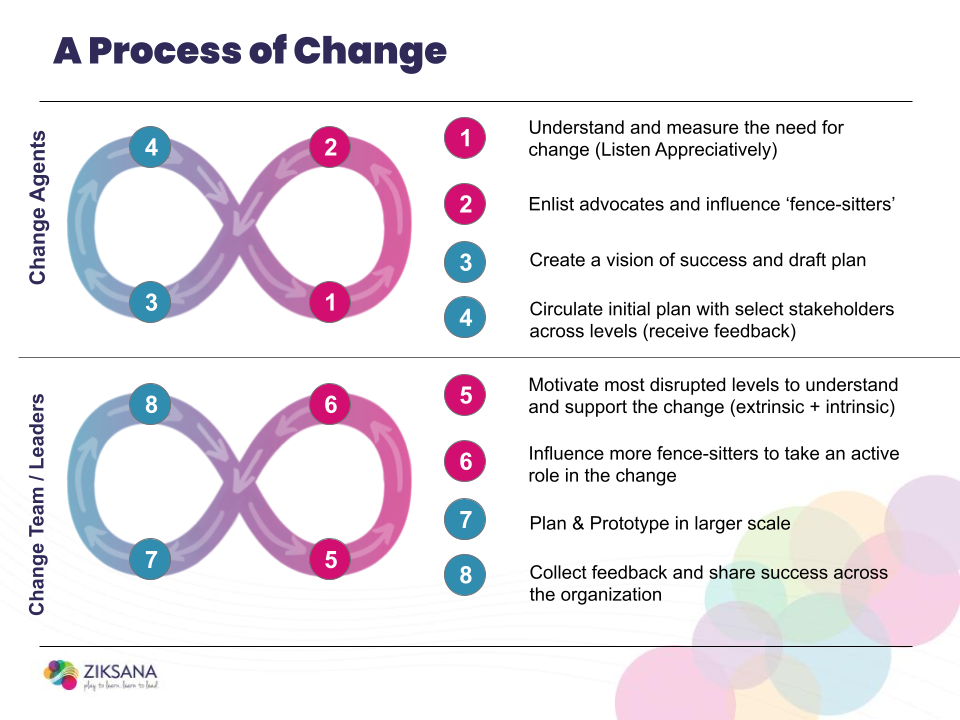
Leaders sometimes have the tendency to overuse their strengths, attempting to lead and manage every aspect of changing organizational culture. We view Organizational Change as a cyclical process that alternates between focusing on results and people, requiring different strengths at different times – and adaptive leadership. Leaders who try to facilitate all cycles with their strengths alone can quickly get stuck.
For example, a leader with strong influencing strengths may shine when it’s time to build a core team of change advocates at the beginning of the first cycle but may struggle to adequately listen to and integrate critical feedback from stakeholders before moving into the second cycle.
As a general rule of thumb, leaders with primarily Relationship and Influencing strengths will perform best on the tasks indicated on the right side of the loop, while leaders with Executing and Strategic strengths will perform best on the left side. Leaders with strengths on both sides of the loop will perform best when they are aware and strategic about which strengths they are relying on at which part of the process.
The Solution: Leading From Your Strengths
Changing Organizational Culture Requires the Right People for the Right Part of the Process
In order to successfully facilitate organizational change, leaders need to develop a core team that is representative of all 4 strength domains. Then, roles should be assigned based on what each domain is best at, with each person feeling empowered to lead their part of the process. By empowering teams, the creative leaders behind them avoid the tendency to lead the entire process single-handedly, instead trusting those with better-suited strengths to lead the parts where they shine.
- Relationship Strengths shine when they are utilized to understand other people’s perspectives, feelings, and feedback. They innately engage in techniques like appreciative listening and teams feel a sense of psychological safety around them. Leaders with primarily relationship strengths are key players at the beginning of the organizational change process and should be tasked with interviewing key stakeholders to assess the need for change. Relationship strengths should also be tasked with collecting feedback throughout the change process, as they are likely to listen empathetically and consider the impact of change on relationships, not just results.
- Strategic Strengths are key during the visioning and planning process. Once stakeholders’ perspectives have been taken into consideration, leaders with strategic strengths should be tasked with creating an initial vision for success and coming up with different ideas of how to get there. Strategic Strengths should be given the lead anytime during the change process when planning and ideation are necessary.
- Influencing Strengths will shine when it’s time to get people on board with a plan. Their persuasive and engaging way of interacting will help motivate those people who are on-the-fence about change to advocate for it. Utilize leaders with influencing strengths whenever it’s time to present a plan or address resistance to change. In the latter situation, pairing those with influencing and relationship strengths is a good strategy to ensure that resistors feel both understood and inspired to get on board.
- Executing Strengths make things happen! Leaders with executing strengths should be in charge of project management, setting deadlines, and keeping people on track at every step of the organizational change process. Whenever it’s time to take action and implement a plan, those with executing strengths should be trusted with the lead.
How Play Prepares Leaders for Organizational Change
At Ziksana, we believe that employing play at work is part of the solution. We use the science of play to empower leaders with experiences that connect them to what change feels like. Research shows that for many animals, play is an adaptive function that helps them practice necessary survival skills.
The same can be said for humans, albeit our environments are typically less life-threatening. However, there are challenges in modern-day organizations that can feel as threatening and high stakes.
Organizational change can be full of fear. On a biological level, dealing with ambiguous situations triggers our “fight-or-flight” response, leading us to quickly take action with the ultimate goal of self-preservation. As a leader, this is problematic. Approaching change from this “triggered” state typically leads to poor decisions that fail to consider the ultimate goal or the other people involved.
If trained leaders hope to respond and adapt to change appropriately, they need to practice navigating ambiguous circumstances with the ability to stay calm, think strategically, consider others, and take bold action. Luckily, engaging in play at work provides a compelling opportunity to practice these skills.
Our research on the impact of playful learning has shown that play prepares leaders to successfully adapt to change in 3 ways:
1. Play Facilitates Adaptive Leadership and Openness in Teams
To successfully adapt to change, playful leaders need to have a curious, open mindset and gather diverse perspectives to inform their actions. When fear is involved, people tend to rely on their pre-existing knowledge and beliefs to inform their decisions quickly.
Play creates a low-stakes environment where leaders can practice these interpersonal skills without feeling defensive. It sets the tone for the type of curious approach that is necessary for adapting to change.
2. Play Facilitates Assertive Leadership and Teams Who Take Action
When faced with change, it is natural to start imagining various approaches to handling it. This isn’t a bad thing. In fact, the ability to anticipate future needs, options, and trends is a defining feature of an adaptive leadership style. However, this becomes problematic when too much time is spent in the analysis at the expense of decisive and necessary action. Adaptive leadership is lost without assertive leadership.
As an adult, playing is a risk in-and-of-itself. Acting silly or impractical, especially around a professional team, can be daunting for many leaders. However, playing together allows leaders to recognize their common humanity, accept their flaws, and be open to taking risks in front of one another.
This experience of psychological safety at work sets a precedent for the type of culture that facilitates a collective willingness to take action and learn from risks. Adapting to change is a constant learning process, and assertive leaders must accept that mistakes will be made along the way. Accepting the inevitability of risk-taking prepares leaders to take action before they feel entirely ready and encourages the same courage from their team members.
3. Play Facilitates Authentic Leadership and Connection To Teams
To successfully employ adaptive leadership and facilitate the process on an organizational level, leaders must articulate the need for change and motivate others to collective action. Without feeling authentically connected, people are unlikely to trust one another and feel safe. To combat this, adaptive leaders need to know how to facilitate a sense of connection and trust among their team and organization.
Play is one of the most basic ways to encourage authentic connection and build trust at work. It provides an opportunity for people to show up as their whole selves, including the spontaneous and creative parts that are often less prominent in a professional environment. This authentic connection builds the type of trust that enables change to occur.
Accelerate Organizational Change With Strength
Ultimately, play is an activity that prepares adaptive leaders to navigate ambiguity and invite others courageously into the process of change. Play provides opportunities for shared authenticity, courage, and curiosity that combat the fear and resistance to change.
A strengths-based approach to leading change requires effective leadership responsibilities to be shared and delegated. Each member of the leadership team should own the parts of the process they’re best at, knowing when it’s time to pass the baton to someone with better-suited strengths. This approach ensures a focus on both results and people is maintained throughout the change process, leading to successful change initiatives that support a healthy culture and bottom line.